
Gas Line Repair in Miami-Dade & Broward County
Leaks, corroded sections, failed connectors and lines that can no longer carry what is being asked of them.
Request Service Now
15+ Years
Serving South Florida
State Licensed
Gas Contractor
Dependable Service
Customer Approved
Commercial Gas
Contractor
A Gas Line Rarely Fails in the Middle
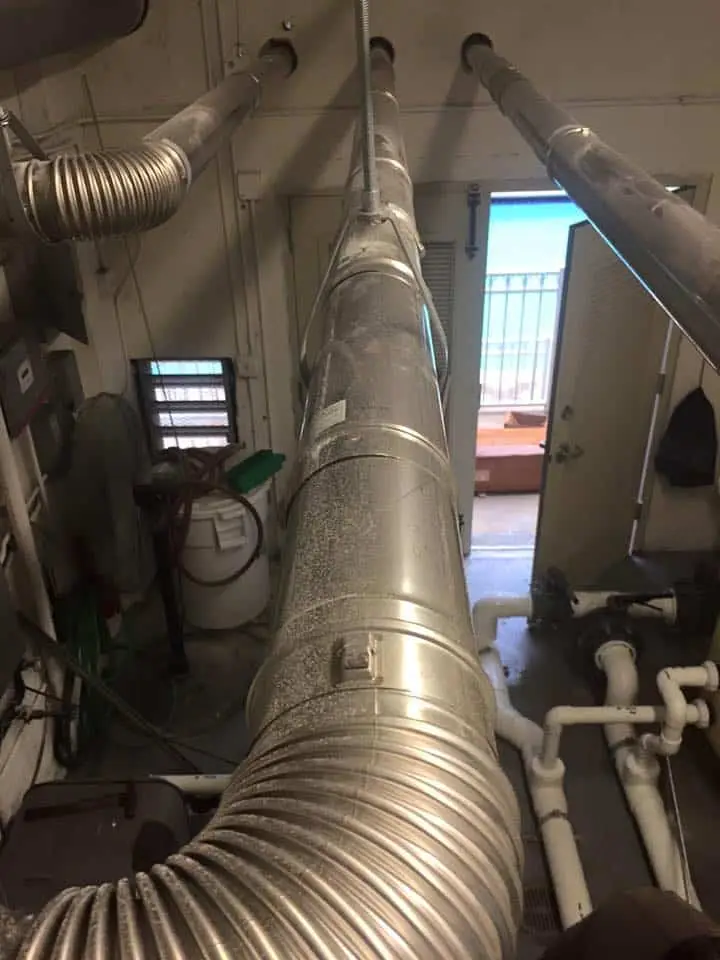
It fails at the ends. Where the pipe leaves the ground, where it comes through a wall, at a threaded joint, at a connector behind an appliance nobody has moved in fifteen years. The long straight run in between is usually the healthiest part of the system.
That matters for what a repair actually looks like. Most of the time it is a section, a fitting or a connector rather than the whole line. Sometimes it is not, and the honest answer then is that patching one more joint on a line that has already been patched twice is money spent twice.
Around the Clock Gas Service is a licensed gas contractor, Florida registration LQ12177, working across Miami-Dade and Broward County.
What the Symptom Usually Means
None of this replaces a look at the system, but it will tell you how much of a hurry to be in.
| What You Notice | What It Usually Points To |
|---|---|
| Rotten egg or sulfur smell | An active leak at a joint, a connector or a valve, or a pilot that has gone out with gas still feeding |
| Hissing near piping or an appliance | A leak large enough to hear, which means leave the building first |
| Gas bill climbing with no change in habits | A leak too small to smell but large enough to meter |
| A dead strip of grass running in a straight line across the yard | A buried yard line leaking. The straight line is the giveaway, because gas displaces oxygen at the root zone along the pipe |
| One appliance weakens when another one fires | Not a leak. The line cannot carry the combined load, usually because something was added to it without resizing |
| Yellow or orange burner flame instead of blue | Incomplete combustion, from a blocked burner, poor combustion air or the wrong orifice. This one is a carbon monoxide conversation |
If you smell gas or hear hissing, stop reading and go outside. The rest of this page will still be here.

Why Older Blocks Keep Running Out of Gas
A lot of the inner suburbs across both counties went up between the 1950s and the 1970s, concrete block, single story, slab. Where gas reached the street, the line into the house was sized for what people ran then: a range and maybe a dryer. That was correct in 1963 and it is the original sin behind a surprising number of repair calls now.
What changes is the load, not the pipe. Somebody adds a tankless water heater, a pool heater, an outdoor kitchen. The line is asked to carry two or three times what it was built for, and the result gets reported as a repair problem because that is what it feels like from inside the house. The burner is weak. The water goes cold when someone starts the dishwasher. Nothing is broken. The pipe is just too small.
There is no basement to run any of it under, so the pipe goes overhead, through the attic, or around the outside of the block. Attics here run brutally hot most of the year, which is hard on flexible connectors and on anyone working up there, and it is why a lot of attic runs have never been properly looked at.
Outside, the failure point is where steel meets ground or comes through a wall. If a sprinkler head is throwing water on that spot, it is aging faster than the rest of the system. Moving the head is free.
Repairing It, Or Replacing It
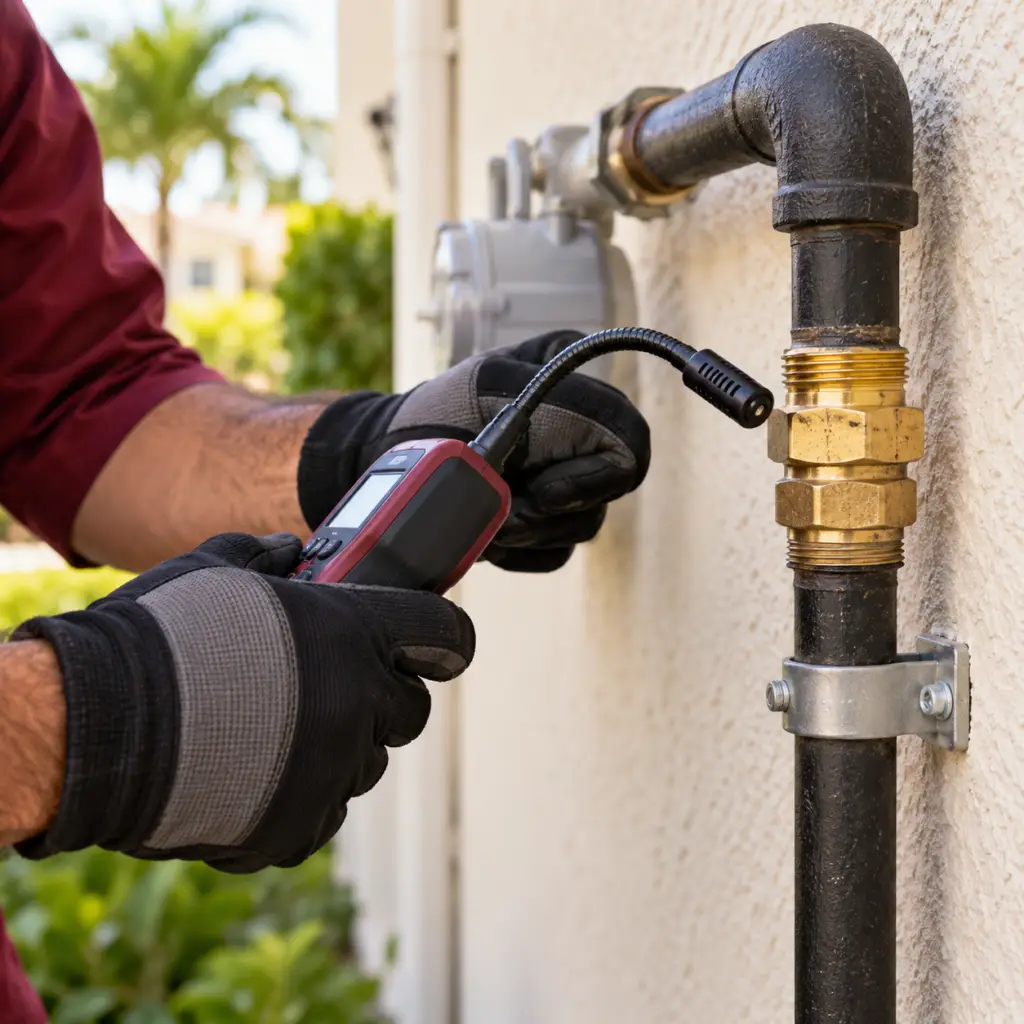
A single failure at a fitting or a connector is a repair, and most calls are exactly that.
The conversation changes when it is the second or third failure on the same line, when the corrosion is general rather than at one point, when the pipe is galvanized, or when the real problem is that the line is undersized for what the house now runs. In that last case a repair fixes nothing, because nothing is broken.
We would rather tell you the line needs replacing before doing a repair that will not hold than after. And if a repair is genuinely the right call, that is the quote you should get.
If You Smell Gas, Leave First
Get everyone out of the building before you do anything else. Don’t flip switches, don’t unplug anything, don’t use the phone inside, and don’t go hunting for the leak yourself. From outside, call your gas utility’s emergency line or 911. That is the right first call at any hour, and it is free. Then call us.
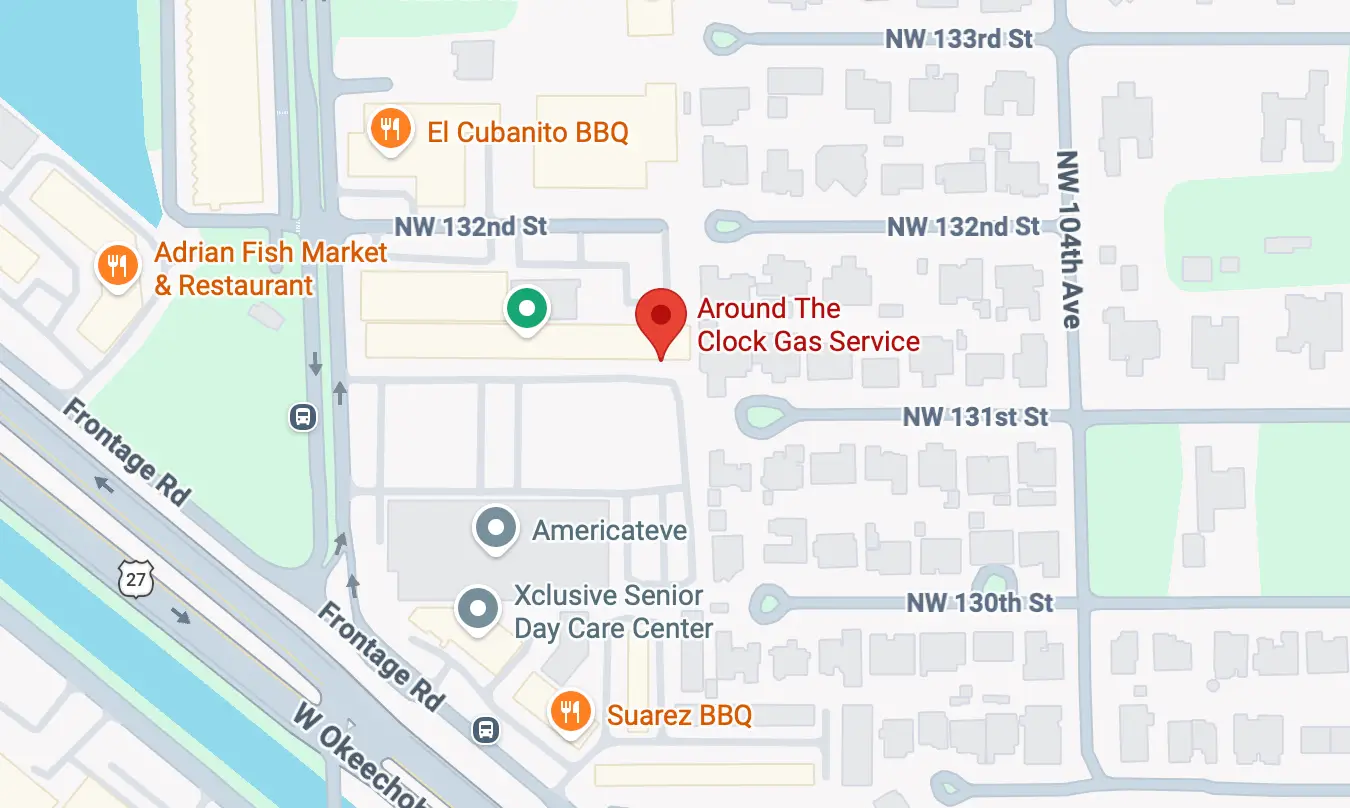
Proudly Serving Miami-Dade & Broward County
We work across Miami-Dade and Broward County from one shop in Hialeah Gardens. Out here traffic decides how long it takes to reach you far more than distance does, so if timing matters for your job, say so and we’ll be straight with you about it.
Miami-Dade County
- Miami
- Miami Beach
- Doral
- Homestead
- North Miami
- Aventura
- Pinecrest
- Key Biscayne
- Hialeah
- Coral Gables
- Kendall
- Cutler Bay
- North Miami Beach
- Sunny Isles Beach
- Palmetto Bay
Broward County
- Fort Lauderdale
- Pembroke Pines
- Coral Springs
- Pompano Beach
- Tamarac
- Weston
- Coconut Creek
- Hollywood
- Miramar
- Davie
- Sunrise
- Deerfield Beach
- Lauderhill
- Margate
Don't Wait On a Gas Problem
Call Around the Clock Gas and get a licensed technician to your door.
Schedule Service or Request a Free Estimate
Have a question, an emergency, or a project in mind?
Call Us
(305) 231-3632
Email Us
Request a Free Quote
Questions About Gas Line Repair
Here are answers to the questions South Florida homeowners ask us most. Need something else? Just give us a call — we’re happy to help.
How do I know if my gas line needs repair?
The signs worth acting on are a sulfur or rotten egg smell, a hissing sound near piping, visible corrosion where a line enters the ground or a wall, a gas bill that has climbed with no change in usage, and a dead strip of grass running in a straight line across the yard. Smell and sound are the urgent two. Go outside first, then call.
My gas bill went up and nothing changed. Could that be a leak?
It can be, and it is one of the more common ways a slow leak gets found. A leak can be far too small to smell and still be large enough to show up on a meter across a month. It is worth ruling out, because a small leak does not stay small on its own.
Can a gas line be repaired, or does it have to be replaced?
Usually repaired. A failure at one fitting, joint or connector is a repair, and that covers most calls. Replacement is the honest answer when the same line has failed more than once, when corrosion is general rather than at a single point, when the pipe is galvanized, or when the underlying problem is that the line is undersized for what the house now runs.
Why does my range go weak when the water heater fires?
That is almost never a leak. It is a sizing or pressure problem: the line cannot carry both loads at once. It shows up most often after something large was added to an existing system, a tankless water heater or a pool heater being the usual culprits. The fix is upstream, in the supply line, not at the appliance.
There is a dead strip of grass across my yard. What is that?
If it runs in a straight line, treat it as a buried gas line leak until proven otherwise. Gas escaping from an underground pipe displaces oxygen at the root zone, and the grass dies along the route of the pipe rather than in a patch. It is one of the few gas problems you can see from the kitchen window, and it is worth a call.