
Tankless Water Heater Installation in Miami-Dade & Broward
Gas tankless units, sized properly, on a line that can actually feed them.
Request Service Now
15+ Years
Serving South Florida
State Licensed
Gas Contractor
Dependable Service
Customer Approved
Commercial Gas
Contractor
Two Things Tankless Is Genuinely better At in South Florida
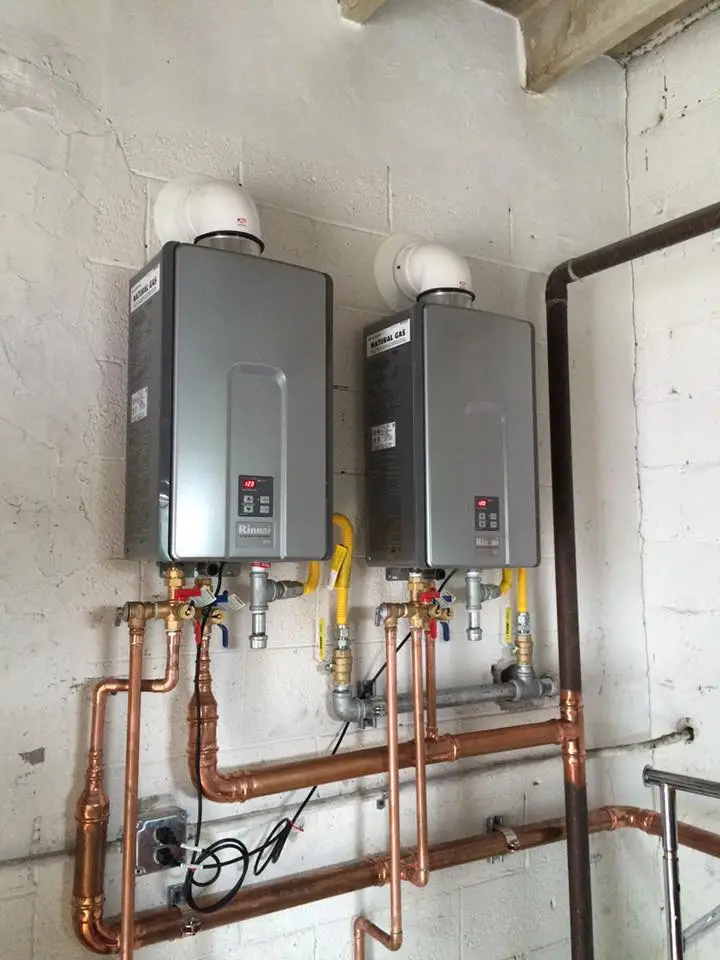
The first one is a local advantage almost nobody mentions. A tankless unit is rated on temperature rise, meaning how far it has to lift the incoming water to reach your tap. Incoming water here is warm all year. The same unit that struggles to deliver two showers at once in a cold-groundwater state will do it comfortably here, because it is doing far less work. Tankless sizing is genuinely easier in this climate, and that is a real difference rather than a sales line.
The second is for houses that sit empty. A tank keeps forty gallons hot around the clock whether anyone is home or not, and plenty of property here is occupied for part of the year. A tankless unit heats nothing until a tap opens. If a house is dark for six months, that is the whole standby loss gone.
What it isn’t is free hot water. It will use less than a tank, and how much less depends on the household. We are not going to put a percentage on this page, because the honest answer is that it depends on how you use it.
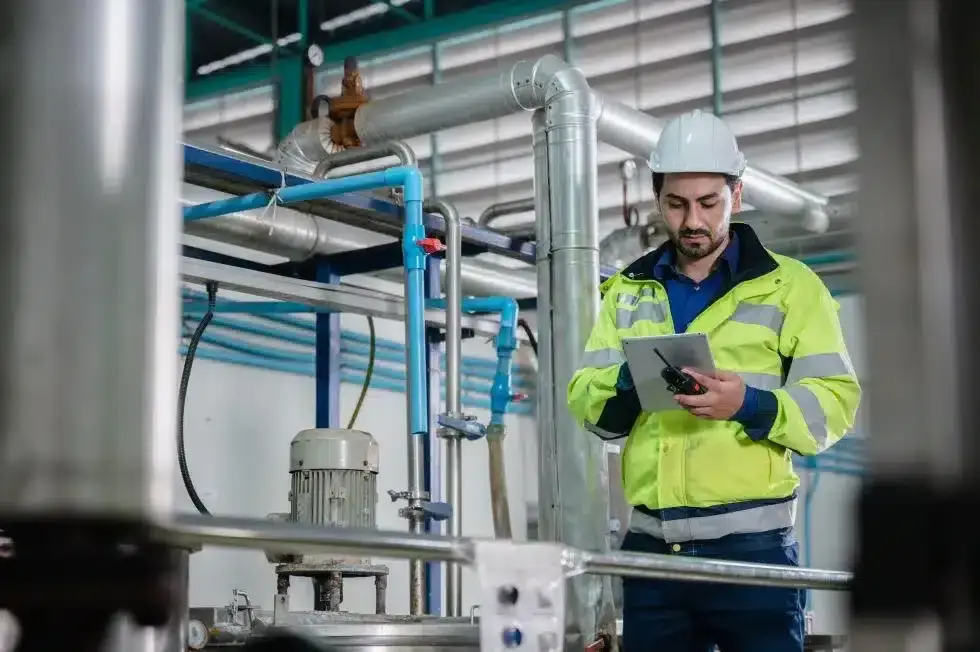
Hard Water is Actually What Kills Them Here
Our water comes out of the Biscayne Aquifer, which is limestone. Rain soaks down through rock, dissolves calcium carbonate on the way, and arrives at your house carrying it. That’s why kettles fur up here and why shower doors need scrubbing.
In a tank, scale settles harmlessly at the bottom for years. In a tankless unit, the same water is pushed through a narrow heat exchanger and heated hard, which is exactly the condition that makes minerals come out of solution and stick. Scale builds on the surface doing the heating.
What that looks like from the kitchen: water that fluctuates hot and cold, a unit that starts throwing error codes, or output that has quietly dropped off over a couple of years. What it looks like on a bill: a heat exchanger, which is most of the cost of the unit.
The fix is descaling, on a schedule rather than when something goes wrong. Manufacturers publish an interval, and those intervals assume average water. Ours is harder than average, so the interval wants to be shorter than the book says. If you’re buying a tankless unit, ask whoever installs it how it gets flushed and whether they fit isolation valves for it, because doing it without them is a much bigger job.
Before You Replace One, Check the Warranty
Tankless units carry long heat exchanger warranties, often considerably longer than people assume, and the paperwork is usually in a drawer rather than in mind.
So if somebody has told you a unit is finished, find out how old it is and what the manufacturer’s coverage says before you agree to replace it. Sometimes the answer is that it’s genuinely done. Sometimes the part is covered and the job is labour. It costs you a phone call to the manufacturer to find out, and it’s worth making that call before the new unit is ordered.
One thing that catches people: neglected descaling is a common warranty exclusion. If a unit has never been flushed in a hard water area, the manufacturer may decline the claim. That’s another reason the descaling schedule matters beyond performance.
What the Install Involves
Step 1
Gas Capacity
Gas capacity first. The connected load for the unit against what the line and the meter can actually carry, and an upgrade where they can’t.
Step 2
Venting
A tankless unit needs its own vent, sized and routed to the manufacturer’s spec, and in the concrete block construction that dominates here that usually means an exterior wall penetration rather than an easy run.
Step 3
Water Connections
Isolation valves for future descaling, and a condensate path if the unit is a condensing model.
Step 4
Commissioning
Pressure test on any gas work, a check that the unit holds temperature at realistic simultaneous demand rather than at one tap, and a walk through how to flush it.
Commercial Tankless
Restaurants, hotels, gyms and multifamily buildings all run hot water demands a residential unit will not cover, and the answer is usually a bank of commercial units rather than one large one. The gas sizing question gets correspondingly bigger. There is more on that on our commercial gas services pages.
The Unit Fits. The Gas Line Is the Question
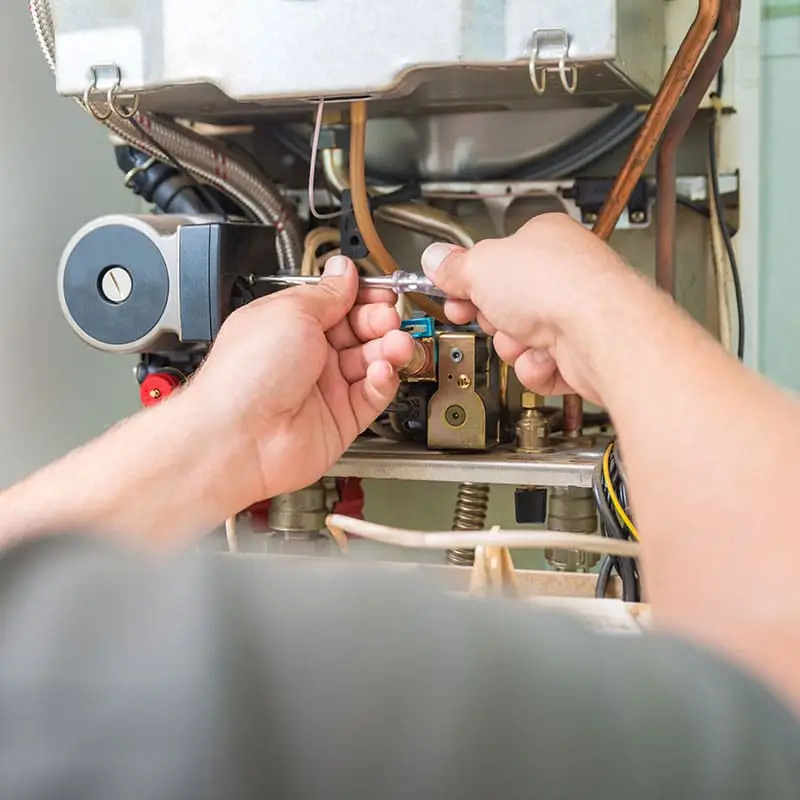
A tankless water heater will mount on the wall where your old tank stood and connect to the pipe that fed it. That’s the problem, not the selling point.
A typical 40 gallon gas tank draws somewhere around 40,000 BTU. A whole-house tankless unit can draw up to 199,000. It’ll connect to the old half inch line, and then it will fail to hold temperature the moment somebody starts the dishwasher while the shower is running. That gets reported as a faulty heater. It’s a starved one.
So the useful sequence is to check the gas line and the meter before choosing the unit, not after it’s delivered.
Around the Clock Gas Service is a licensed gas contractor, Florida registration LQ12177, working across Miami-Dade and Broward County.
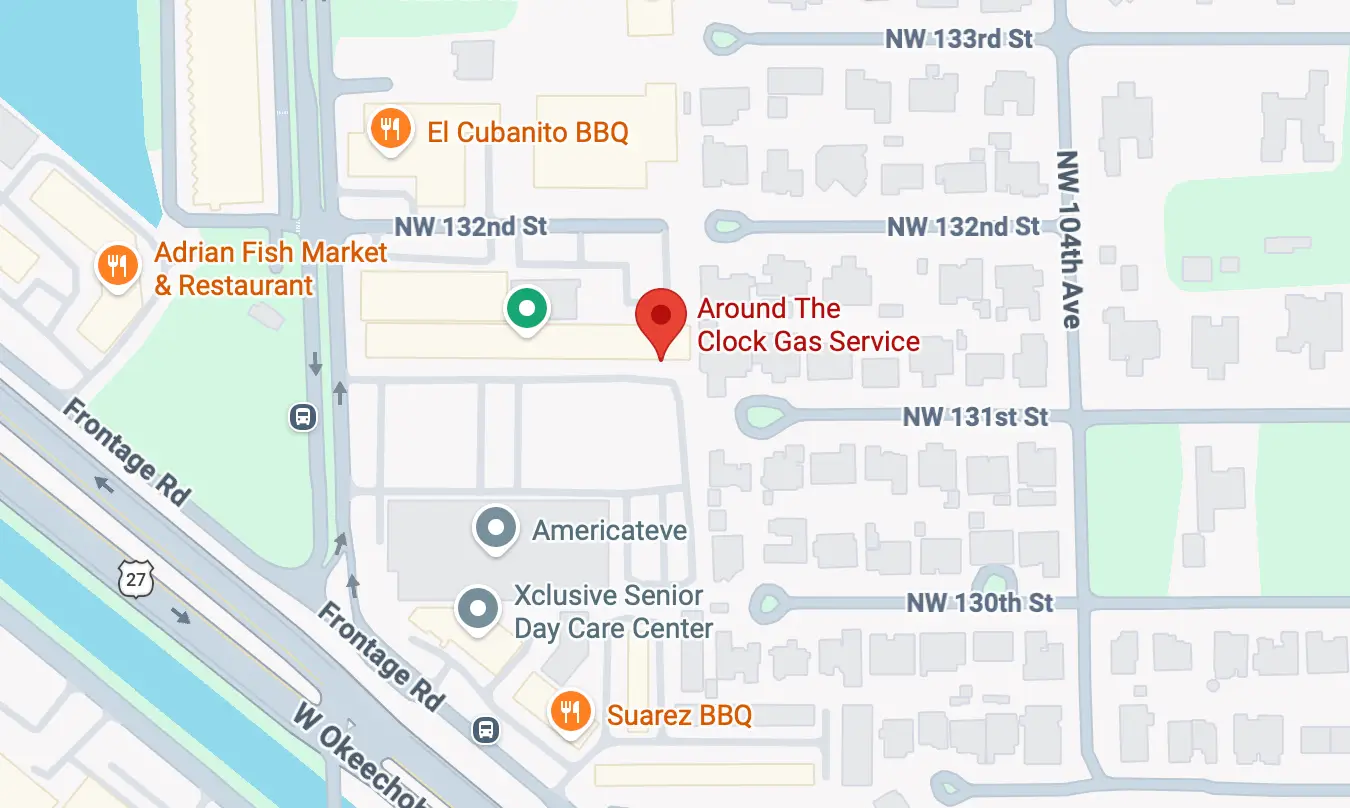
Proudly Serving Miami-Dade & Broward County
We work across Miami-Dade and Broward County from one shop in Hialeah Gardens. Out here traffic decides how long it takes to reach you far more than distance does, so if timing matters for your job, say so and we’ll be straight with you about it.
Miami-Dade County
- Miami
- Miami Beach
- Doral
- Homestead
- North Miami
- Aventura
- Pinecrest
- Key Biscayne
- Hialeah
- Coral Gables
- Kendall
- Cutler Bay
- North Miami Beach
- Sunny Isles Beach
- Palmetto Bay
Broward County
- Fort Lauderdale
- Pembroke Pines
- Coral Springs
- Pompano Beach
- Tamarac
- Weston
- Coconut Creek
- Hollywood
- Miramar
- Davie
- Sunrise
- Deerfield Beach
- Lauderhill
- Margate
Don't Wait On a Gas Problem
Call Around the Clock Gas and get a licensed technician to your door.
Schedule Service or Request a Free Estimate.
Have a question, an emergency, or a project in mind?
Call Us
(305) 231-3632
Email Us
Request a Free Quote
Tankless Water Heater Questions
Here are answers to the questions South Florida homeowners ask us most. Need something else? Just give us a call — we’re happy to help.
Do I need a bigger gas line for a tankless water heater?
Usually, and it is the thing to check before buying the unit. A 40 gallon tank draws around 40,000 BTU; a whole-house tankless can draw up to 199,000. The unit will physically connect to the old line and then underperform the moment two fixtures run at once. Check the line and the meter capacity first, because that answer sometimes changes which unit makes sense.
How often does a tankless unit need descaling here?
More often than the manual assumes. Manufacturer intervals are written for average water, and ours comes out of a limestone aquifer carrying dissolved calcium. Scale forms on the heat exchanger, which is the part doing the heating and the expensive part to replace. Ask about isolation valves at install time, because flushing a unit without them is a much bigger job.
Will a tankless water heater work in a power cut?
No, and it surprises people every hurricane season. Gas tankless units need electricity for the ignition, the controls and usually a fan, so no power means no hot water even though the gas is still on. A conventional tank with a standing pilot will keep whatever is already hot in it. If riding out outages matters to you, that belongs in the decision.
Are tankless water heaters worth it?
It depends on the house. They use less energy than a tank because nothing is kept hot while you are out, which is worth more in a property that sits empty for part of the year. They deliver hot water without running out, which is worth more in a full house. Against that: a bigger gas line, a proper vent, and descaling on a schedule. We are not going to put a savings percentage on it, because it depends entirely on how you use hot water.
My tankless unit is fluctuating between hot and cold. What is that?
Most often scale on the heat exchanger, especially if it has never been flushed. It can also be an undersized gas line showing up under simultaneous demand, or a flow rate too low to keep the burner lit at one fixture. Those are three different fixes, so it is worth diagnosing rather than guessing, and the first question is always when it was last descaled.